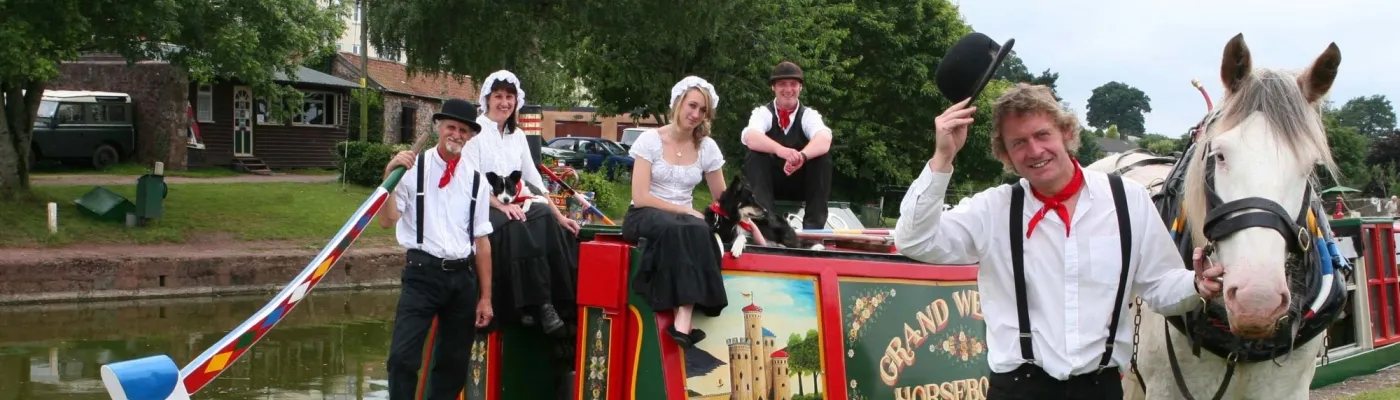
A Brief History of the Grand Western Canal.
In 1796 an Act of Parliament granted permission for the Grand Western Canal to be built. It was to be part of a grand design to avoid the long and dangerous voyage around Lands End by linking the Exeter Ship Canal with the Grand Western Canal and onto the Bridgwater & Taunton Canal.
John Rennie surveyed the canal’s route and supervised the construction work between 1810 and 1814.
In 1814 a section of the canal was completed from Tiverton to Westleigh, and after many delays the Canal was extened from Lowdwells to Taunton in 1838. This section had 7 tub-boat lifts and an incline plane. By then the plans to link to the English Channel and the Bristol Channel had been abandoned.
At the beginning of the 19th century the Horse-drawn Barge was one of the cheapest and fastest means of commercial transport and the Grand Western Canal worked commercially for 130 years. However, the Canal also witnessed the intrusion of the Railways with an aquaduct designed by Isembard Kingdom Brunel being built to carry the canal over the Great Western Railway branch line to Tiverton in 1838. With the advent of the railways the much of the trade was taken from the Canal and in 1865 the section from Lowdwells to Taunton was sold to the railway company and abandoned. The last steam train on this line was the “Tivvy Bumper” which can be seen today at Tiverton Museum.
The section between Tiverton and Westleigh remained open and for a short time the Canal was profitable mostly carrying coal and limestone in horse drawn tub boats from the quarries to the kilns at Tiverton, this continued until the 1920’s. The stone was fired in the kilns to make lime for farming and house building. There was also a thriving trade in harvesting the white water lilies and selling them at Covent Garden Market in London.
The canal slowly fell into disrepair and was largely unused until the 1960’s when proposals to fill in the canal were heard of by local residents who formed a group to save the canal. The campaign proved successful and in 1971 Devon County Council took ownership and declared the Canal a Country Park. In 2006 achieving recognition as a Local Nature Reserve.
Many of the original structures can still be seen today and some are protected by Grade II listing, including the Tiverton Basin and Waytown limekilns, road bridges designed by John Rennie and the 40m long Waytown Tunnel.